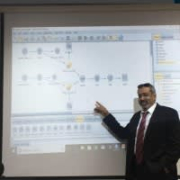
Celonis empowers businesses with process mining, offering automation and AI features that visualize processes, identify bottlenecks, and optimize operations. With seamless integration and user-friendly tools, Celonis adds significant value to businesses aiming for operational efficiency.
Celonis is a leading tool for process mining and optimization, seamlessly connecting with SAP and Oracle systems through pre-built connectors. Its capabilities include visualizing processes, identifying inefficiencies, and optimizing workflows with comprehensive dashboards and action flows. While Celonis scores high on functionality, integration with Microsoft, Azure connectivity, and an improved pricing model are areas for improvement. Training resources and an intuitive interface are essential for users managing frequent updates and complex programming needs. With robust process analysis and automation features, Celonis enhances decision-making and resource allocation.
What key features does Celonis offer?
- Process Mining: Visualizes and analyzes business processes to identify inefficiencies.
- Automation: Enables streamlined, automated workflows for improved productivity.
- AI Capabilities: Enhances process optimization and decision-making with advanced AI.
- Integration: Offers pre-built connectors for seamless integration with SAP and Oracle.
- Dashboards: Provides comprehensive views of operations to monitor performance.
What benefits or ROI should reviewers look for?
- Operational Efficiency: Identifies and resolves bottlenecks, improving workflows.
- Resource Optimization: Enables better allocation and utilization of resources.
- Informed Decisions: Data-driven insights support strategic decision-making.
- Cost Management: Streamlines processes, reducing operational costs.
In finance, procurement, and supply chain, Celonis is utilized to monitor and optimize entire business processes, analyzing data from systems like SAP and Oracle to uncover inefficiencies. Organizations leverage its process analysis and automation triggers for improved performance and resource allocation.
IBM SPSS Statistics is renowned for its intuitive interface and robust statistical capabilities. It efficiently handles large datasets, making it essential for data analysis, quantitative research, and business decision-making.
IBM SPSS Statistics offers extensive functionality supporting both beginners and experts. It is used for data analysis across industries, accommodating advanced statistical modeling such as regression, clustering, ANOVA, and decision trees. Users benefit from its quick model building and ease of use, which are indispensable in data exploration and decision-making. Room for improvement includes charting, visualization, data preparation, AI integration, automation, multivariate analysis, and unstructured data handling. Enhancements in importing/exporting features, cost efficiency, interface improvements, and user-friendly documentation are sought after by users looking for alignment with modern data science practices.
What are IBM SPSS Statistics' most notable features?
-
Intuitive Interface: Simplifies navigation for both beginners and experts.
-
Predictive Analytics: Advanced modeling capabilities for future trends.
-
Robust Statistical Functions: Includes regression, clustering, ANOVA, and decision trees.
-
Large Dataset Handling: Efficiently manages complex and sizable data.
-
Customizable Tables: Users can create tailored reports and exports.
What benefits and ROI do users report in reviews?
-
Ease of Use: Streamlined processes for rapid analysis.
-
Advanced Functionality: Comprehensive tools for diverse research needs.
-
Quick Model Building: Speeds up predictive and statistical analysis.
-
Versatile Application: Suitable for academic, business, and social science research.
IBM SPSS Statistics is implemented broadly, including academic research for in-depth studies, business analytics for informed decision making, and in the social sciences for comprehensive data exploration. Organizations utilize its advanced features like AI integration and automated modeling across sectors to gain actionable insights, streamline data processes, and support research initiatives.