PeerSpot is the internet’s leading go-to spot for top tech decision-makers to connect with peers across all areas of enterprise tech in today’s fast-paced tech environment. Our intelligent community of leading tech professionals openly share their expertise on how to make tech run smoother, easier, and safer for everyone.
If you or your organization are ready to evaluate different SIEM (Security Information and Event Management) solutions or you are looking to update your current solution to one that might be a better fit for your growing organization, this is the spot to learn from our valued users - your peers - on the best SIEM solutions for 2024.
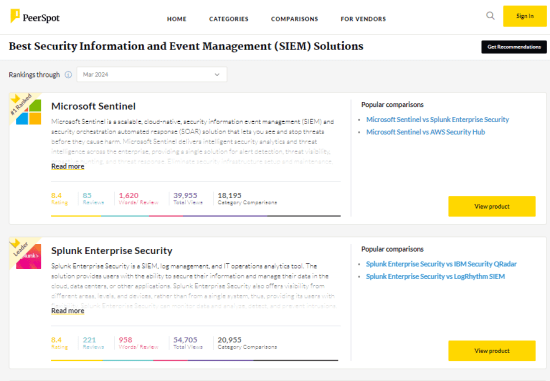
Microsoft Sentinel represents a significant advancement in the field of Security Information and Event Management (SIEM). As a cloud-native SIEM solution, Sentinel provides comprehensive security analytics across an enterprise's entire digital environment. It integrates AI and automation to enhance its efficiency and effectiveness in monitoring, detecting, and responding to security threats.
The platform is designed for scalability, supporting the extensive data needs of large organizations while enabling rapid deployment alongside existing SIEM systems if required. Microsoft Sentinel facilitates advanced threat detection by leveraging cloud-native tools, aiming to improve response times and reduce manual tasks through automation.
Splunk Enterprise Security is a highly regarded SIEM (Security Information and Event Management) solution that offers robust capabilities for monitoring, alerting, and responding to security threats within an organization. Splunk's SIEM system is designed to provide real-time visibility into an organization's security posture by analyzing data collected across the network. This includes logs, transactions, and other data sources, which Splunk uses to identify abnormal activities and potential security incidents. The solution is known for its scalability and flexibility, accommodating a wide range of security needs from small businesses to large enterprises. Additionally, Splunk's SIEM provides detailed investigative capabilities and easy-to-use dashboards, which facilitate quick responses to identified threats, thus helping to mitigate risks more effectively.
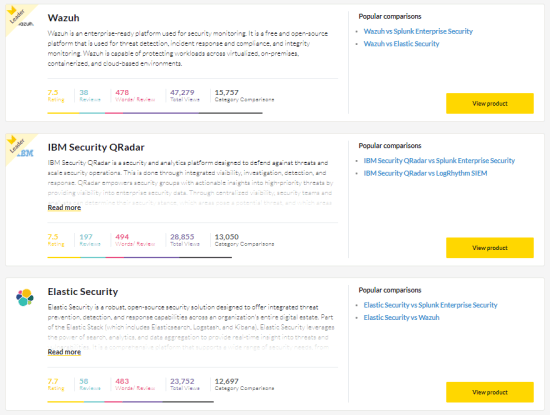
Wazuh is a prominent Security Information and Event Management (SIEM) platform known for its open-source nature and robust security features. As a SIEM solution, Wazuh offers comprehensive security monitoring and protection capabilities for IT assets. It aggregates and analyzes real-time telemetry data to facilitate effective threat detection and compliance management.
Designed with a focus on scalability and flexibility, Wazuh supports both small and medium-sized enterprises by providing an accessible, cost-effective SIEM tool. Its open-source framework allows organizations to customize and extend its capabilities to fit their specific security needs. Wazuh also unifies XDR (Extended Detection and Response) and SIEM into a single security platform, enhancing endpoint and cloud workload protection, and offering a holistic approach to organizational security management.
IBM Security QRadar is a comprehensive Security Information and Event Management (SIEM) system that provides centralized surveillance of an organization's security posture. As a leading SIEM solution, QRadar integrates sophisticated analytics to detect, prioritize, and respond to potential security threats across an enterprise's network. It utilizes a variety of data from network devices, endpoint logs, databases, and more, offering real-time monitoring and incident response capabilities. QRadar enhances security operations by offering streamlined and intuitive dashboards for threat investigation, and its automated analytics help in quickly identifying and remediating security vulnerabilities. The tool is engineered to support cloud environments as well as traditional on-premise setups, ensuring broad and adaptable coverage for modern IT infrastructures.
Elastic Security is a comprehensive integration that enhances traditional SIEM (Security Information and Event Management) functionalities by combining them with endpoint protection and response capabilities. Utilizing the robust infrastructure of Elasticsearch for data storage, management, and real-time search capabilities, Elastic Security offers an effective and scalable solution for threat detection and response. It integrates seamlessly with Kibana, serving as the primary user interface, which simplifies the visualization and analysis of security data.This platform is notable for its dual capability in managing both SIEM and EDR (Endpoint Detection and Response) from a single solution, providing users with powerful analytical tools to address and mitigate security incidents as they happen. Elastic Security’s SIEM component is specifically designed to aggregate and analyze security data from various sources in real time, enhancing the ability of security teams to respond to threats promptly and efficiently.
There are so many more amazing SIEM tools available today to fit every business need. To learn more about other SIEM tools, read more reviews and comparisons and learn about your peers' experiences using these SIEM tools, please click here.