Consultant at a tech company with 10,001+ employees
21
Updated:Aug 31, 2021
Intelligent Document Processing (or IDP) is the missing link towards implementing end-to-end automation, especially in paper-based work environments. Paper still forms a part of business operations and wherever paper is involved, latency and error due to human handling does creep in. OCR does enable businesses to ingest data into the digital workflow. However, one should remember that while using OCR, the quality of the scanned documents has to be good in order to ingest data in a highly accurate manner. As the popular adage goes, “Garbage In; Garbage Out”. OCR processing is very much similar. Intelligent Document Processing goes much beyond. It allows the user to perform pre-processing steps to improve the image quality and post-processing to improve the data quality and accuracy.
How does Intelligent Document Processing enable business operations?
In a multi-vendor scenario, businesses receive invoices from different vendors in different formats. Similarly, other documents, such as contracts, statements of work, purchase orders and other such lengthy documents, don’t have any particular structure and vary from vendor to vendor.
Intelligent Document Processing helps here. It uses a template-free approach based on the in-built artificial intelligence/machine learning algorithms. It classifies the documents into various categories, extracts the relevant information, and validates it so that it can be processed further.
The output is highly accurate and it is directly integrated into the downstream systems including different applications, ERP systems, workflows, DMS systems, etc. To improve the accuracy levels, the tool comes with in-built pre-processing and post-processing features.
Pre-processing features improve the OCR issues such as lack of clarity, carbon smudges, skewness, noise, contrast, etc. Post-processing features resolve issues such as 5/S, 1/l, 8/B, m/rn, etc. Together they enhance the accuracy levels and throughput of Intelligent Document Processing by manifolds.
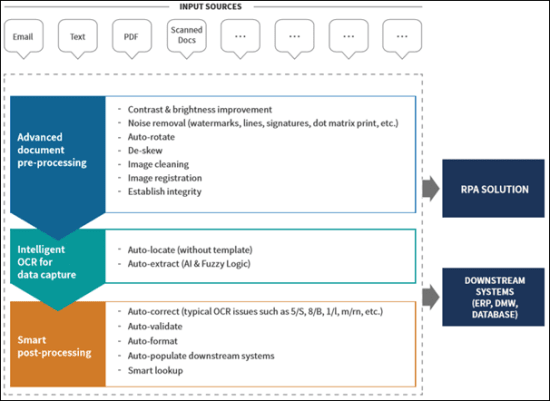
Prominent pre-processing and post-processing features
The most important pre-processing functions include deskewing, sub-imaging or separating an area out from the main image before processing, line removal, image resizing, and inverse text correction or white to black colored text correction. It also includes noise removal, capture lens focusing or alignment for precision capturing, smoothening character edges, intelligent cropping, color correction, image cleaning, image correction, character correction, page bursting into multiple sub-sections, image mirroring, page recognition, etc.
The post-processing functions are required to improve the data capture accuracy from the enhanced image. It includes auto-location of data in an image without the reference of a template, auto-extraction of data, auto-correction of the captured data, auto-validation, auto-formatting, etc. All these features together make the intelligent data capture much more formidable and acceptable as compared to only OCR.
Astounding business benefits brought forth by Intelligent Document Processing
Reading text from PDF images of hard copies allows businesses to undertake more complex use cases, by the day, for automation. Some of these include mobile onboarding, video KYC, claims processing, patient onboarding, identity verification at transit points, summarizing lengthy documents, etc.
Intelligent Document Processing also allows to process all documents types including paper-based ones, classify documents into predefined categories, extract information from unstructured documents, index the documents, and convert the document to a format, which is ready for further processing. It allows converting unstructured data to structured data, which can be easily integrated with downstream systems including enterprise applications, databases, etc. It improves speed and productivity by manifolds even in a paper-driven environment.
Simply put
Intelligent Document Processing is the missing link towards achieving end-to-end automation where paper is still used for different processes. Pre-processing and post-processing feature tremendously improve the accuracy of ingesting the data from unstructured documents. It enhances the throughput and productivity and takes it to the next level allowing the traditional businesses to compete with their digital-born counterparts.

Intelligent Document Processing is crucial for companies, enabling streamlined data management. Important aspects include:
Enhanced accuracy in data extraction
Improved efficiency and productivity
Cost reduction through automation
Scalability and flexibility in processing
The importance of Intelligent Document Processing lies in its ability to transform unstructured data into structured formats...
Intelligent Document Processing is crucial for companies, enabling streamlined data management. Important aspects include:
Enhanced accuracy in data extraction
Improved efficiency and productivity
Cost reduction through automation
Scalability and flexibility in processing
The importance of Intelligent Document Processing lies in its ability to transform unstructured data into structured formats swiftly and accurately. This transformation significantly reduces manual errors and enhances the quality of data management. Businesses benefit from improved decision-making since reliable data is readily available. Automation also saves time, allowing employees to focus on higher-value tasks rather than mundane data entry.Intelligent Document Processing holds importance in its scalability. As companies grow, the volume of documents increases, requiring a solution that can adapt to this growth without extra resource allocation. IDP offers flexibility, allowing companies to scale their operations efficiently. Cost reduction is another critical factor, as IDP limits the need for extensive labor-intensive processes, reducing operational costs. Incorporating IDP maximizes ROI, presenting an opportunity for businesses to allocate resources more strategically.
An intelligent document processing solution is a form of intelligent automation that uses data science to enhance human understanding of unstructured data. IDP solutions convert both unstructured and semi-structured information from documents such as emails and images into structured, usable information. In turn, IDP solutions help businesses across all industries better manage documents, strea...
An intelligent document processing solution is a form of intelligent automation that uses data science to enhance human understanding of unstructured data. IDP solutions convert both unstructured and semi-structured information from documents such as emails and images into structured, usable information. In turn, IDP solutions help businesses across all industries better manage documents, streamline their business processes, and improve their workflows. In addition, they help organizations meet compliance standards and reduce errors. They can often be used instead of expensive, difficult-to-manage database systems, helping your organization save money.
There are several advantages of using an IDP solution that can benefit both your organization as well as your employees. They help you incorporate data into workflow processes in a fast and easy way. The fact that you can speed up your processes is a huge plus, since handling large quantities of data can be very time-consuming for your employees. With reduced processing times, you also eliminate the need to hire as many employees, or you can assign those employees to higher-priority tasks where needed. Because IDP solutions eliminate manual processes in the workplace, it allows employees to use their expertise to offer a better customer experience and stop wasting time on document management. Subsequently, when customers have a better experience, it opens up other opportunities for your business. In addition, IDP solutions can increase customer satisfaction by reducing turnaround times. And by eliminating the need for manual work and data entry, IDP solutions can also massively reduce the risk of human error.
Consequently, because IDP solutions can automate tasks and reduce the risk of human error, it also means they can help businesses to be more compliant. Using IDP solutions make compliance much simpler because there is always a digital trail, which can be used when auditing and ensuring compliance with data protection regulations.
Not only do IDP solutions help your organization use time more efficiently, but because they can transform physical documents into editable digital versions in a matter of seconds, they help boost productivity and ensure accuracy. To top that, when IDP solutions help your business convert paper-based documents into a digital format, it puts your organization ahead of your competition.
DP tools can help save on other operational costs, as well. You will see a better and faster return on investment (ROI) than with other software or with human employees. Another important benefit of IDP solutions is that they can be applied to multiple applications. IDP is easily scalable and can help automate several important processes across your organization. The good thing about it is that it does not require installation and instead serves as a platform that can interpret several different types of documents, regardless of their source or size, without needing to install different software or set rules.
Lastly, IDP solutions are easy to integrate with your existing software and hardware. Because you can implement them with your existing tech stack, you do not need to spend money on new devices or technology to make them work. This makes the implementation of IDP solutions much easier, simpler, and more cost-effective.
Download our free Document Automation Software Report and find out what your peers are saying about Conga, Notion, SS&C Technologies, and more! Updated: May 2026.